Compliance Checklists
 DVIR to Repair: Where Fleet Maintenance Accountability Breaks Down
With DVIR compliance and vehicle safety in focus, Brake Safety Week is August 23–29 this year, and CVSA says inspectors will place additional emphasis on brake drums and rotors.
That makes this a good time to talk about something bigger than inspection week: What happens after a driver finds a problem?
A driver identifies a defect. A driver vehicle inspection report (DVIR) gets submitted.
Then what?
For many fleets, that’s where the process becomes less clear, and where DVIR compliance can start to break down.
What Should Happen After a Defect Is Reported?
Under 49 CFR §396.11, motor carriers must address reported defects or deficiencies that are likely to affect safe vehicle operation. The carrier must certify that the defect was repaired or that repair was unnecessary before the vehicle is operated again when the regulation requires it.
The regulation is reasonably straightforward.
The handoffs aren’t always.
Effective fleet maintenance compliance depends on more than a driver identifying a problem. It depends on what happens to that information next.
Where Does DVIR Accountability Break?
Usually somewhere between the driver’s report and the completed repair.
A driver may report a defect correctly, but maintenance doesn’t see it immediately. Safety assumes maintenance owns it. Maintenance assumes dispatch has been notified. Dispatch still needs the truck.
Or the repair gets completed, but the documentation never makes its way back to the original defect record.
Each person may have done part of the job. The question is whether the process completed the job.
That distinction matters. A fleet can have responsible employees and still have gaps in its DVIR repair process if ownership and documentation aren’t clear.
Closing the Loop on DVIR Compliance
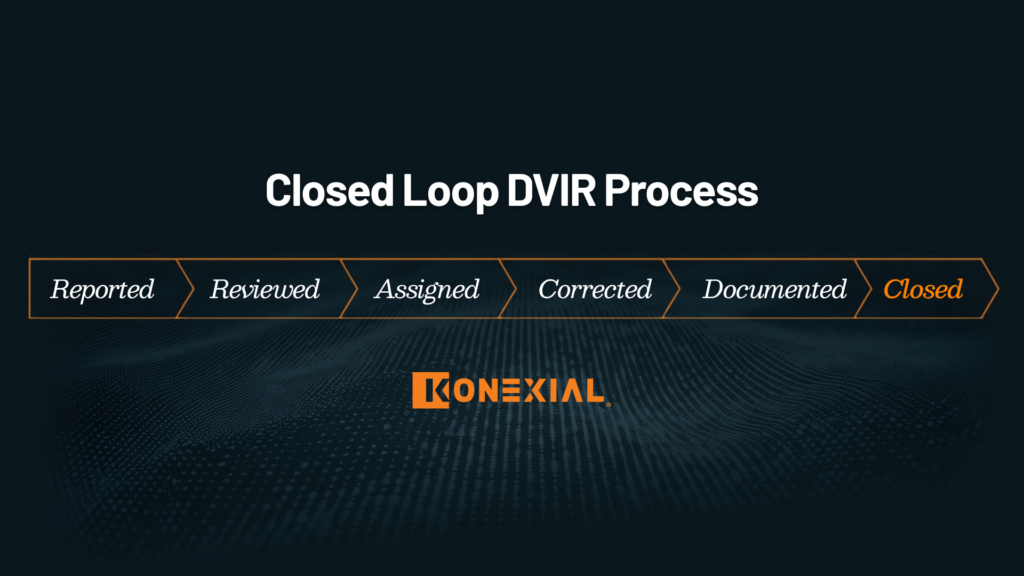
A useful DVIR process should allow a safety manager to trace a reported defect through its entire lifecycle—from discovery to resolution.
Every fleet may handle that workflow differently, but the essential questions are the same:
- Who receives the driver’s report?
- How is the severity of the defect determined?
- Who prevents equipment from being dispatched when appropriate?
- Where is the repair documented?
- Who closes the issue?
- Can the fleet later prove what happened?
Those are safety questions—not just maintenance questions.
Closing the loop means the fleet can connect the original vehicle defect with the action that followed, rather than relying on separate systems, emails or individual employees to reconstruct the story later.
Recurring Vehicle Defects Deserve Attention
Suppose a brake issue is identified on a tractor and repaired.
Problem solved.
Then another related defect occurs three weeks later. Then another.
If each repair is viewed independently, the fleet may technically close three maintenance items while missing a larger pattern.
Safety managers should be able to identify recurring defects by vehicle, component or equipment type. A repeated brake issue, for example, may warrant a different response than three unrelated repairs.
That visibility is particularly relevant during enforcement campaigns such as Brake Safety Week, but it matters year-round.
Why Maintenance Data Matters for Fleet Maintenance Compliance
This is where unified fleet information becomes important.
Konexial includes ELD, DVIR and compliance capabilities within a broader platform that also works with telematics, video and other fleet information.
The goal isn’t to create a giant dashboard filled with more things to look at. It’s to make important questions easier to answer:
What was reported? When? Which vehicle? Was the issue repaired? Is it happening again?
If answering those questions requires searching email, a maintenance application, a DVIR system and someone’s spreadsheet, the fleet has created unnecessary risk in the process.
Connecting maintenance and safety information can make it easier to document action, spot recurring vehicle defects and demonstrate a consistent compliance process.
Is a DVIR Required When No Defects Are Found?
For most property-carrying operations covered by §396.11, federal rules do not require a DVIR when the driver finds no defect or deficiency.
Different requirements can apply to passenger-carrying operations, and individual fleet policies may require additional documentation.
The important point is that DVIR compliance is not simply about producing inspection forms. It is about responding appropriately when defects are identified.
Brake Safety Week Is a Test, Not the Objective
Fleets understandably prepare for enforcement events.
But the real objective isn’t getting through August 23–29 without a violation. It’s ensuring that the truck on the road on September 10—or February 10—is safe to operate too.
A strong DVIR repair process isn’t measured by the number of inspection forms completed.
It’s measured by what happens when somebody finds something wrong.
Before Brake Safety Week, select several recent DVIR defects and trace each one from the driver’s report through the final repair. If you can’t follow the entire trail, that’s the process to address first.