Compliance Checklists
 Simplifying the Agriculture Exemption with Technology
TL;DR: The AG exemption allows drivers transporting agricultural commodities within a 150 air-mile radius of the source to bypass FMCSA Hours of Service regulations. This supports ELD compliance and boosts efficiency during planting and harvest.
y, and ROI.
Simplifying Compliance for Agricultural Fleets
When planting and harvest seasons hit, time becomes the most valuable commodity for agricultural haulers. Every minute spent calculating logs or confirming exemption status is a minute not spent delivering critical commodities to farms, feedlots, or processors. That’s where the 150 air-mile radius comes in — and why understanding it (and automating compliance with it) is crucial for agriculture transporters.
The 150 air-mile radius, part of the Federal Motor Carrier Safety Administration (FMCSA) agricultural exemption, is designed to give flexibility to drivers transporting agricultural goods. It helps reduce unnecessary downtime, providing relief from certain Hours of Service (HOS) regulations when operating close to the source of agricultural commodities. Proper use of the agricultural exemption can mean the difference between on-time deliveries and lost productivity.
However, interpreting and applying the rule manually can be complicated. That’s where technology, especially advanced ELD (Electronic Logging Device) automation and geofencing, makes all the difference. With advanced telematics systems, agricultural haulers can eliminate the guesswork, simplify compliance, and focus on what really matters: productivity and profitability.
What is the 150 Air-Mile Rule for Agriculture Exemption?
The agricultural exemption allows drivers transporting agricultural commodities to operate within a 150 air-mile radius from the source of those commodities without being subject to standard FMCSA HOS requirements.
This exemption originates from FMCSA regulation 49 CFR §395.1(k) and is commonly referred to as the agriculture exemption in trucking. Its purpose is to provide operational flexibility for drivers who work in seasonal, time-sensitive agricultural operations.
Essentially, it acknowledges that agricultural haulers often have unique demands compared to general freight carriers. These haulers frequently operate within localized regions, moving commodities from farms to processing or storage facilities. The 150 air-mile exemption gives them the flexibility they need without being restricted by traditional drive-time limitations that apply to long-haul carriers.
Who Qualifies?
The 150 air-mile radius applies to motor carriers and drivers who transport:
- Agricultural commodities (e.g., grains, feed, produce)
- Livestock (all living animals cultivated, grown, or raised for commercial purposes, such as cattle, sheep, horses, swine, goats, insects, and aquatic animals like fish and crawfish.
- Farm machinery and equipment
- Farm supplies such as fertilizers, seed, and chemicals
Agriculture vs. Standard ELD Exemptions
It’s important to distinguish between agricultural exemptions and standard ELD exemptions. While some drivers are fully exempt from using an ELD (for instance, short-haul or pre-2000 engine drivers), agricultural haulers typically still require ELDs.
In practical terms:
- Inside the 150 air-mile AG Circle: HOS limits do not apply, and time is considered exempt.
- Outside 150 air-miles: The ELD resumes standard tracking automatically, and HOS rules apply.
This flexibility is valuable — but only if fleets can track it accurately.
When and Where the Ag Exemption Applies
The Ag exemption only applies during state-defined planting and harvest seasons, which vary by location. Each state publishes specific dates, and the FMCSA maintains a registry for reference. Fleets operating across multiple states must be especially careful to track these timeframes.
The rule applies only within 150 air-miles of the commodity’s source. Once the driver exceeds that radius, the exemption ends, and the ELD begins recording regulated driving time.
This ensures a balance between flexibility for agriculture and safety on public highways — provided drivers and fleets apply it correctly.
The Real-World Challenges of Manual Compliance
Despite its seemingly simple premise, the 150 air-mile exemption for ag can be tricky to manage manually. Agricultural logistics often involve multiple pickup points, variable routes, and state-to-state operations all of which make tracking the exemption manually both tedious and error-prone.
- Air-Miles vs. Statute Miles: Drivers and dispatchers often confuse air-miles with statute miles. All road maps and mapping applications use statute miles as their unit of measure. Air-miles are calculated “as the crow flies” a straight-line distance factoring in the curvature of the earth, not the miles actually driven on the road. Without digital mapping tools or automated systems, calculating that radius accurately is nearly impossible for drivers in the field. One air mile equals 1.1508 statute miles. 150 air miles equals 172.61692 statute miles. Most AG shippers underestimate the size of their AG circle because they use the wrong unit of measure, statue miles versus air miles.
- Manual Logging Errors: When drivers manually switch between exempt and non-exempt status based on their physical location compared to a theoretical geographic circle, mistakes are inevitable. Forgetting to change duty status, miscalculating when the exemption begins or ends, or underestimating/overestimating distances can all trigger HOS violations, unrealized exemption potential and audit discrepancies.
- Lost Productivity and Compliance Risks: Manual tracking and status changes consume valuable time especially during busy harvest seasons when every hour counts. Fleets relying on paper logs or outdated ELD annotation workflows risk inconsistent data, regulatory penalties, and operational slowdowns.
- Increased Driver Frustration: Drivers often find manual exemption tracking confusing and stressful, especially when they’re under time pressure. Confusion about whether the exemption applies can create unnecessary anxiety and affect driver morale and retention.
How Technology Simplifies the Agriculture Exemption
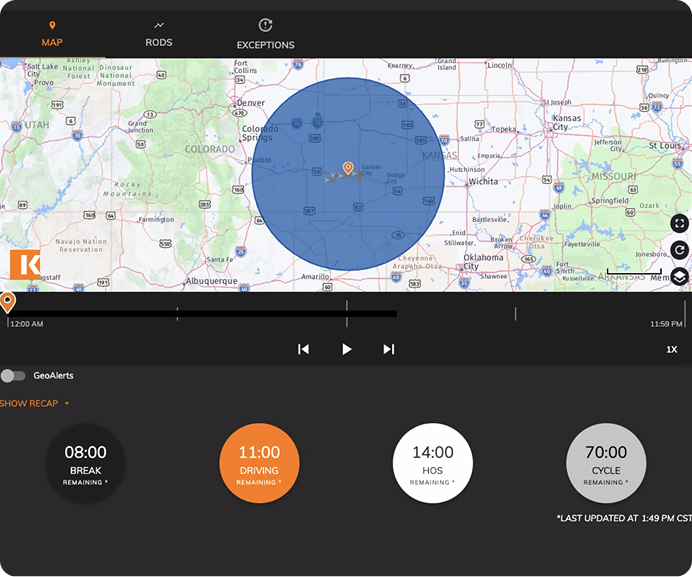
The good news? Modern telematics and ELD technology has evolved to remove the complexity of compliance. Fleets can now use automation, GPS tracking, and geofencing to apply the ag exemption accurately and effortlessly.
Automated Geofencing
Edge computing ELDs use geofencing technology to automatically detect when a vehicle enters or leaves a 150 air-mile radius from the source. Drivers no longer need to manually stop the truck to change their duty status; the ELD system updates it automatically based on real-time GPS positioning.
Advanced ELD systems continuously monitor the vehicle’s distance from the source location. If the driver remains within the 150 air-mile boundary, the time is automatically logged as exempt agricultural operations. Once the vehicle exits that boundary, normal HOS tracking resumes.
This automation prevents accidental overages or violations, ensuring compliance even when drivers are focused on the road. It also creates digital proof of when exempt status begins and ends a key benefit during inspections or audits.
Data Accuracy and Simplified Audits
With automation, fleets get precise, timestamped, GPS-verified data for every trip. This level of accuracy simplifies recordkeeping, reduces paperwork, and helps fleets demonstrate compliance confidently.
Key Benefits of Technology-Enabled Compliance:
- Auto-calculated exemption zones
- Seamless exempt/non-exempt transitions
- Reduced driver workload
- Improved fleet productivity
- Enhanced accuracy during audits
Ag Exemption in the Real World
Consider a mid-sized agricultural hauler operating across the Midwest during planting season. Before automation, drivers tracked their own air-mile calculations manually — often resulting in incomplete logs or inconsistencies. Compliance managers spent hours every week cross-checking mileage and correcting records before submitting them for FMCSA review.
After adopting a Konexial ELD with automatic agricultural exemption tracking, the company saw immediate improvements:
- 15% reduction in downtime caused by manual log corrections
- 30% faster driver onboarding thanks to automated compliance features
- 100% accuracy in exemption zone detection, verified during FMCSA audits
- Fewer HOS violations and smoother roadside inspections
With Konexial’s geofencing and live edge computing automation, the fleet eliminated compliance uncertainty, reduced paperwork, and empowered drivers to focus on driving, not documentation.
Choosing the Right ELD for Agricultural Exemptions
Not all ELDs are created equal and when it comes to agriculture exemption compliance, the right technology makes all the difference.
Features to Look For in an ELD
- Automatic Agricultural Exemption Detection “Ag Mode” The ELD should automatically recognize and apply the exemption based on GPS location.
- FMCSA-Certified Hardware Always verify that your device is listed on the FMCSA’s approved ELD registry.
- Advanced Geofencing and GPS Accuracy Look for liveGPS precision and edge computing technology to ensure compliance accuracy across wide rural regions.
- Cloud-Based Reporting and Integration Cloud storage ensures easy data retrieval, integration with other fleet systems, and simplified audits.
- Reliable, U.S.-Based Support Agricultural fleets operate long hours, often in rural areas your provider’s support should match your work schedule.
Turning Compliance into Competitive Advantage
The Ag exemption was designed to make life easier for agricultural drivers, not harder. But without automation, it often creates confusion, wasted time, and compliance risk. Technology changes that equation.
Konexial’s Ag mode ELD represents the next step in compliance automation. Combining geofencing, real-time GPS position reporting, cloud reporting, and U.S.-based support, Konexial helps fleets achieve seamless compliance while keeping America’s agricultural economy moving. Learn how Konexial’s automatic agriculture exemption ELD simplifies compliance and boosts fleet efficiency.
Visit Konexial.com to explore solutions designed for the modern agricultural fleet.